
Who are we?
We are a small group of students and recent graduates of the social sciences and humanities who are looking to reimagine what academic discourse (and publication) can look like. Having met, worked and researched within a university setting, it has become increasingly clear to us and many of our peers that the scholarly parameters within which knowledge is produced and considered legitimate often excludes the very cultures, stories, and people that our research intends to engage. There has been an increasing urgency to bridge such gaps between research, visual arts, oral histories, labour, etc. and represent them beyond paywalled journals, expensive monographs, or gated lecture and conference halls. This is of course a common critique of academia and other such exclusive towers — the art world, the world of politics, the world of finance — which act as overarching spaces that seek to delineate pathways for people, humanity, earth, but are monodirectional in their communication.
It is not possible to resolve such a schism with a single project, however the effort to imagine new ways of engaging scholarly studies may at least contribute to new and grassroot directions for knowledges to speak with each other in more fluid ways. Our intention is therefore to put together a series of projects and publications that unite interdisciplinary forms of research and meaning making, is as accessible as possible, and gives room for radical experimentation of form. This means placing the essay, the performance, the illustration, the home video, the recipe, craft, side by side in an eclectic collection of important conversations being had in the myriad forms they take.
Why Sassafras?
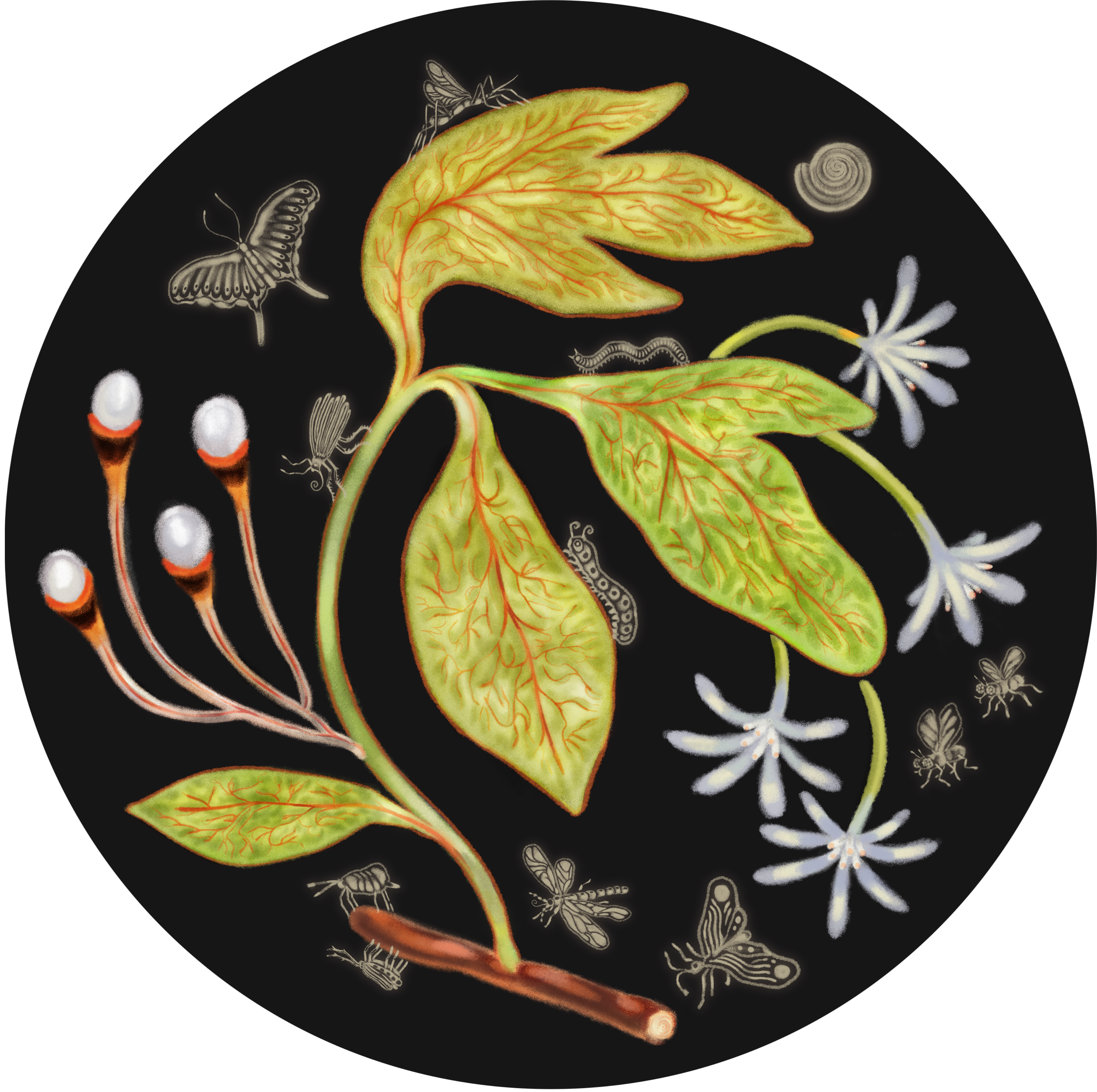
Sassafras is the name of a plant native to North America. It produces three differently shaped leaves on a stem — a mitten shape, a goose foot, and an ordinary ovate form. It has a distinctive taste and smell (a bit like citrus) and produces deep purple berry stems late summer, and tiny yellow flowers in the spring. The origins of its name are somewhat debated, however it may be derived from Sasaunckpamuck (as it was called by the Nipmuck), while others say it has Spanish and Latin origins in the word 'saxifrage', which means 'stone breaker'.
Its leaves, bark, roots, and oils were often ground up and used in cooking or as medicinal cures by indigenous peoples across North America. During the colonial period in the early 1600s, Europe became fascinated by the plant and saw it as a panacea — having the ability to 'purify' blood, heal syphilis, rheumatism, french pox, etc. It became the second largest extracted resource from North American colonies, second only to Tobacco.
By the 1960s some studies showed that Safrole (an oil that is present in sassafras stems and roots) may be carcinogenic, and it was quickly banned from commercial use and sale. The study has since been called into question, and many still use parts of the tree in local recipes, teas, and notably gumbo, in which ground Sassafras leaves are a key thickening ingredient.
What makes Sassafras both interesting and unusual is its general unknowability alongside its massive influence. Its iterations include key roles in various foods, medicines, magic cures, poison, and illegality (for the sale of its roots). This offers a character that encompasses the many aspects of movement, and what it means to exist through space and time as a constantly changing thing — that is, where your meaning becomes contingent upon your context. This is true for many things of course, but the Sassafras really embodies this state of ambiguity, and is therefore resonant in histories of social politics and migration.